
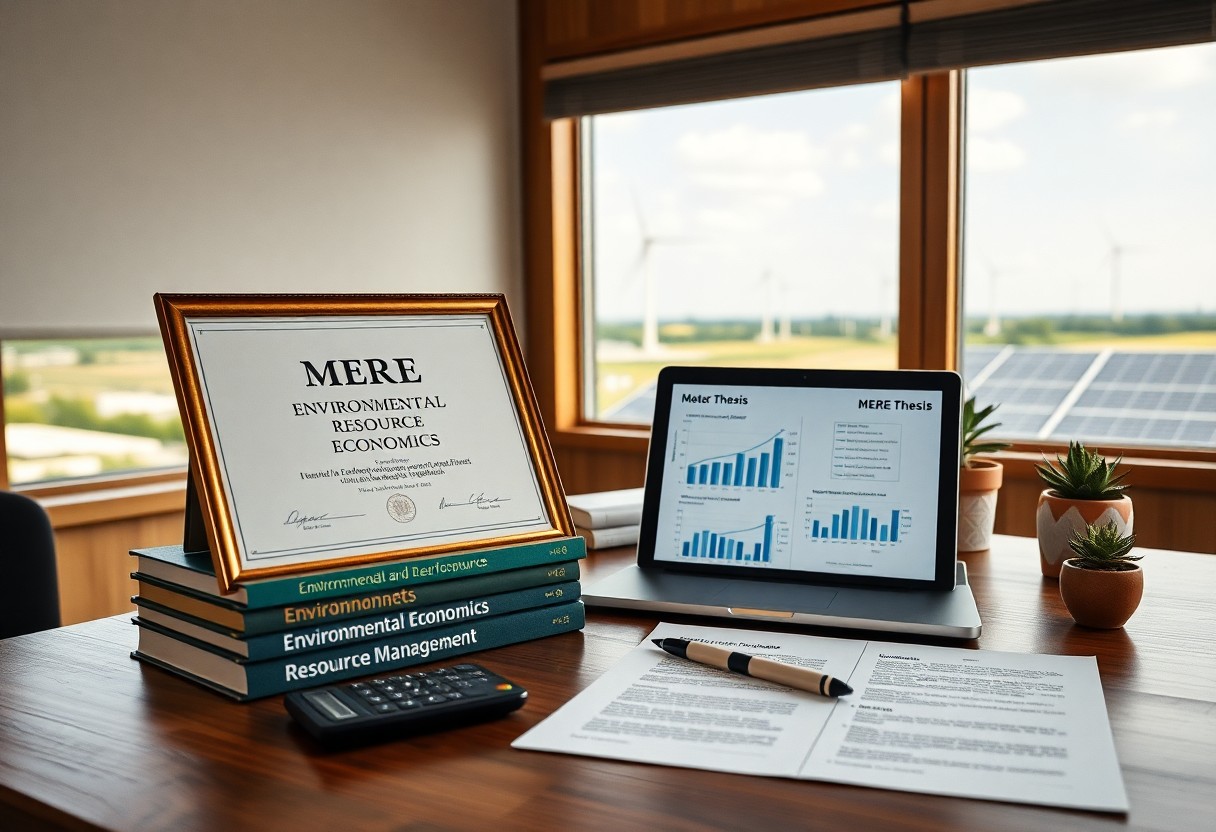
With growing demand for experts who can analyze environmental challenges through an economic lens, you pursue the Master of Environmental and Resource Economics (MERE) to build specialized skills in sustainability, policy evaluation, and resource management grounded in rigorous economic theory and real-world application.
Key Takeaways:
- The Master of Environmental and Resource Economics (MERE) program focuses on applying economic principles to environmental issues like climate change, natural resource management, and sustainability.
- Students gain analytical tools to assess the economic impact of environmental policies and design market-based solutions such as carbon pricing or pollution permits.
- The curriculum blends economics, data analysis, and environmental science, preparing graduates for roles in government, international organizations, and research institutions.
- Many MERE programs offer opportunities for fieldwork, policy modeling, and collaboration with environmental agencies or NGOs.
- Graduates are equipped to contribute to evidence-based decision-making in areas such as renewable energy, conservation, and sustainable development.
The Calculus of the Wilderness
You measure wild spaces not in acres alone, but in the quiet exchanges between species, soils, and seasons. Every decision ripples through ecosystems with precision that mirrors mathematical rigor. This is where economics meets ecology-not with equations on paper, but with trade-offs in real forests, rivers, and communities.
Valuation of the Untamed
Value emerges in the unseen-clean water filtered by wetlands, pollination carried on insect wings. You learn to assign numbers without reducing worth, capturing what markets miss. These estimates shape policy, revealing the quiet economic power of untouched landscapes.
Principles of Natural Capital
Nature functions as a living balance sheet, offering services that sustain economies and lives. You treat forests, fisheries, and soils as productive assets, not infinite resources. Accounting for their depreciation changes how development is planned and judged.
Each ecosystem delivers flows-flood control, carbon storage, habitat-that replace costly infrastructure. You track these services using biophysical data paired with economic models, ensuring they appear in national accounts and corporate disclosures. Mismanaging them risks both ecological collapse and economic loss, making accurate assessment a cornerstone of sustainable policy.
The Wealth of the Commons
You explore how shared resources shape economic decisions in AEM 6510 – Environmental and Resource Economics, where theory meets real-world challenges through accessible models and data-driven insights.
Allocation of the Finite Stream
Time governs how you distribute non-renewable resources across generations. Each extraction choice today alters availability tomorrow, requiring careful balance between immediate gains and long-term sustainability in managing finite natural stocks.
Dynamics of Renewable Harvests
Growth rates define your harvesting limits when managing renewable resources. You must align extraction with natural regeneration to prevent depletion and maintain ecosystem stability over time.
Renewable resources follow biological growth patterns, often modeled using logistic functions. Your optimal harvest strategy adjusts to population size, ensuring yield does not exceed the stock’s capacity to replenish. Overharvesting disrupts this balance, leading to collapse, while underharvesting sacrifices potential welfare. You learn to identify maximum sustainable yield and economically efficient harvest paths, applying dynamic optimization to real-world fisheries, forests, and grazing systems.
The Hand of Policy
Policy shapes how societies manage natural resources and respond to environmental challenges. You operate within frameworks that balance economic activity with ecological limits, using tools that guide behavior toward sustainability. These mechanisms determine who benefits, who bears costs, and how equitably outcomes are distributed across communities and generations.
Incent游戏副本 for the Common Good
Incentives align private decisions with public environmental goals. You encounter subsidies for clean energy, tax breaks for conservation, and payments for ecosystem services that reward stewardship. These tools encourage actions that benefit society while allowing flexibility in how individuals and firms meet environmental objectives.
Regulation of Industrial Encroachment
Regulation sets clear boundaries on industrial activity to protect ecosystems and communities. You face rules limiting pollution, restricting land conversion, and mandating environmental reviews. These measures prevent irreversible damage by ensuring development does not override ecological integrity.
Industrial expansion often threatens sensitive habitats and overburdens local resources. You must comply with zoning laws, emission caps, and permitting processes designed to assess and mitigate harm. Regulatory enforcement holds firms accountable, ensuring that growth does not come at the expense of air, water, or biodiversity crucial to long-term well-being.
The Quantitative Path
You build analytical strength through rigorous training in quantitative methods tailored to environmental challenges. This path sharpens your ability to interpret complex data, test hypotheses, and support policy decisions with empirical evidence. Each course strengthens your command of tools used by leading economists in resource management and sustainability analysis.
Econometric Modeling of the Wild
You apply regression techniques to real-world ecological data, uncovering patterns in species behavior, pollution impacts, and conservation outcomes. These models help predict how ecosystems respond to human activity, giving you the skills to assess environmental policies with precision and confidence.
Statistical Foundations of Resource Use
You master probability distributions, hypothesis testing, and inference methods specific to natural resource datasets. This foundation allows you to draw valid conclusions from field surveys, satellite imagery, and environmental monitoring systems, ensuring your analyses reflect real-world conditions.
Understanding variability in natural systems begins with sound statistical practice. You learn to design studies that account for spatial correlation, measurement error, and non-normal data-common features in environmental research. These skills enable accurate estimation of resource trends, from groundwater depletion to forest growth, forming the backbone of evidence-based decision-making in your work.
The Professional Vocation
You step into a role where economic insight meets planetary responsibility. This degree sharpens your ability to assess environmental policies, model resource use, and guide decisions that balance growth with sustainability. Your expertise becomes a compass in complex debates over climate, energy, and equity.
Analysts of the Global Landscape
Every day, you interpret data that reveals how economies interact with ecosystems. You track emissions trends, evaluate carbon pricing mechanisms, and assess the impact of trade on natural resources. Your analysis informs strategies that align economic activity with environmental limits.
Architects of a Sane Commerce
You design economic models that reject endless extraction in favor of regeneration. Your work promotes pricing systems reflecting true environmental costs, shaping markets that reward stewardship over depletion. Commerce, under your guidance, becomes a force for long-term balance.
Being an architect of sane commerce means redefining profitability to include ecological health. You develop frameworks where businesses thrive by reducing waste, conserving energy, and investing in equitable access to resources. Your influence turns theoretical sustainability into operational practice across industries.
Conclusion
You gain advanced understanding of environmental challenges and economic tools to address them through the Master of Environmental and Resource Economics (MERE). This program equips you with analytical skills to assess policies, manage natural resources, and contribute to sustainable development with confidence and precision.