
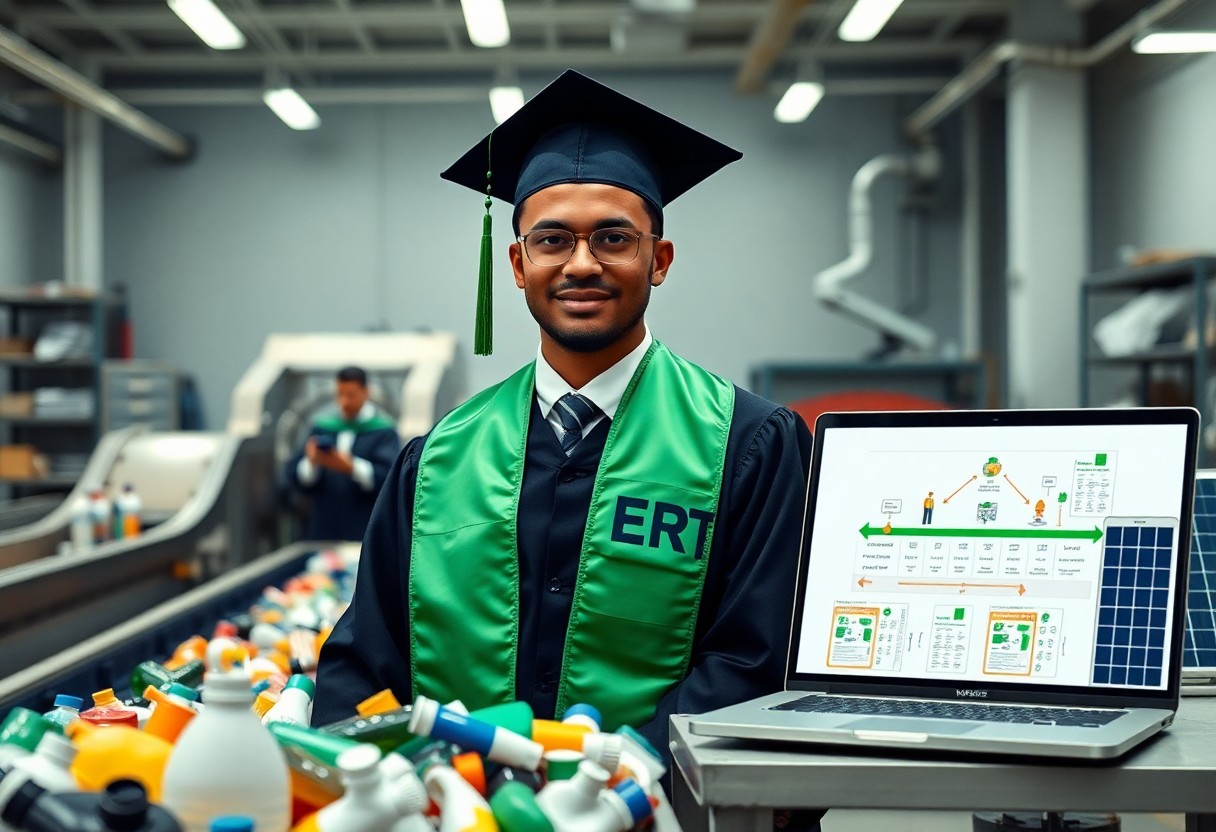
There’s a growing demand for professionals who can design sustainable solutions in waste management and environmental protection. The Master of Environmental and Recycling Technology (MERT) equips you with advanced knowledge in recycling processes, pollution control, and resource recovery, preparing you to lead innovation in a rapidly evolving field focused on planetary health and circular economies.
Key Takeaways:
- The Master of Environmental and Recycling Technology (MERT) is a specialized postgraduate program focused on sustainable waste management, resource recovery, and pollution control technologies.
- Students gain hands-on experience with modern recycling systems, environmental monitoring tools, and circular economy models through lab work and field projects.
- The curriculum integrates engineering, environmental science, and policy to prepare graduates for technical and managerial roles in public and private sectors.
- Graduates often pursue careers in waste treatment facilities, environmental consulting, government agencies, or research institutions working on sustainability initiatives.
- The program emphasizes practical problem-solving for real-world environmental challenges, such as plastic pollution, electronic waste, and industrial emissions.
The Fragile State of Our Natural World
Every day, ecosystems around the globe show deeper signs of strain. You see it in vanishing species, warming oceans, and unpredictable weather patterns. Human activity has pushed natural systems beyond their limits, disrupting balances that took millennia to form. This fragility isn’t distant-it’s visible in your air, water, and soil.
Accumulation of Human Remnants
Plastic chokes waterways, electronics pile in landfills, and chemical residues seep into soil. You live in a world shaped by what you discard. These remnants don’t disappear-they linger, break down into toxins, and re-enter the food chain. The planet now carries the weight of generations of unchecked waste.
Necessity for Ecological Expertise
You face complex environmental challenges that demand specialized knowledge. Pollution, resource depletion, and climate shifts require more than goodwill-they need technical insight and practical solutions. Experts trained in environmental systems are vital to guide effective action and policy.
Ecological expertise bridges science and real-world application. You need professionals who understand material lifecycles, can design closed-loop recycling systems, and assess environmental impact with precision. These specialists don’t just analyze problems-they develop measurable strategies to reduce harm, restore balance, and transform how societies manage resources. Their work starts in data but leads to tangible change in communities and industries.
The Architecture of the MERT Curriculum
You follow a structured path that blends science, engineering, and policy to build a comprehensive understanding of environmental systems. Each module connects directly to real-world challenges, ensuring your learning remains focused and applicable throughout the program.
Scientific Foundations of Sustainability
You explore core principles like material cycles, energy flow, and ecosystem dynamics. These concepts ground your understanding of how natural systems interact with human activity, shaping the scientific basis for sustainable decision-making in your field.
Engineering Solutions for the Future
You design innovative systems for waste valorization, water purification, and renewable energy integration. These projects emphasize efficiency, scalability, and environmental compatibility, preparing you to implement technologies that meet tomorrow’s ecological demands.
Engineering Solutions for the Future pushes you to rethink traditional approaches by integrating smart materials, circular design, and digital monitoring tools. You prototype responses to pollution and resource scarcity, testing them under realistic conditions to ensure practical impact in industrial and urban environments.
Innovations in Resource Reclamation
You’re witnessing a transformation in how waste is perceived-no longer an endpoint, but a starting point. Advanced systems now recover valuable materials from complex waste streams with unprecedented efficiency, turning discarded electronics, plastics, and industrial byproducts into high-quality feedstocks. These innovations redefine circularity, making resource reclamation a cornerstone of sustainable industry.
Chemical Transformation of Matter
Chemistry reshapes what’s possible in recycling. You can now break down polymers to their molecular building blocks, purify contaminated materials through selective reactions, and convert organic waste into platform chemicals. These processes allow you to regenerate materials without downgrading, closing loops in ways mechanical methods alone cannot achieve.
Precision Sorting Technologies
Sensors identify material composition in real time as items move along conveyor belts. You rely on hyperspectral imaging, AI-driven pattern recognition, and robotic arms to separate plastics, metals, and composites with remarkable accuracy. This level of detail ensures higher purity in recycled fractions and reduces contamination across processing lines.
Machine learning models continuously improve detection by analyzing vast image datasets of waste materials, adapting to new packaging formats and composite structures. You benefit from modular sorting units that integrate directly into existing facilities, scaling throughput without sacrificing precision. These systems respond dynamically to fluctuating waste compositions, maintaining consistent output quality important for high-value recycling markets.
The Philosophy of Circular Economic Models
You embrace a system where waste becomes a resource, redefining how materials flow through production and consumption. By designing out waste from the start, circular models keep resources in use longer. Learn more about how this approach drives innovation in the Environmental and Recycling Technology – Career Wise program.
Closing the Loop of Production
You shift from a take-make-dispose pattern to one where products are designed for reuse, repair, and recycling. This loop ensures materials remain in circulation, reducing dependency on virgin resources and minimizing environmental harm through smarter industrial design.
Reducing the Global Anthropogenic Footprint
You actively contribute to lowering humanity’s environmental impact by transforming waste streams into valuable inputs. Every recycled ton of material reduces emissions, conserves energy, and decreases pressure on ecosystems already strained by overconsumption and pollution.
Each decision you make in material selection, process efficiency, and end-of-life management directly influences planetary health. By prioritizing closed-loop systems, you help dismantle linear practices that have fueled decades of unchecked resource extraction and environmental degradation.
Global Stewardship and Practical Application
You are shaping a sustainable future by applying advanced technologies to real-world environmental challenges. This program equips you with the tools to lead impactful initiatives across industries and geographies, turning theory into measurable ecological progress.
Restoring Habitats Through Technology
Technology enables precise monitoring and rehabilitation of degraded ecosystems. You deploy sensors, drones, and data analytics to assess ecosystem health, track species recovery, and implement targeted restoration strategies that accelerate natural regeneration.
Implementation Across Diverse Ecosystems
Each environment presents unique challenges, from arid deserts to coastal wetlands. You adapt recycling and remediation techniques to local conditions, ensuring solutions are effective, culturally appropriate, and ecologically sound across varied landscapes.
Diverse ecosystems demand tailored approaches grounded in local data and community input. You analyze soil composition, water availability, and biodiversity patterns to customize interventions. Whether reprocessing waste in urban centers or deploying bioremediation in rural watersheds, your methods reflect deep environmental understanding and technical precision, ensuring long-term resilience and system-specific success.
Professional Horizons for Earths Guardians
You stand at the threshold of a growing field where purpose meets innovation. Environmental challenges demand skilled professionals who can turn policy into practice and vision into action. With the Master of Environmental and Recycling Technology, your expertise becomes a catalyst for measurable change across industries committed to planetary well-being.
Leadership in Green Innovation
Leadership begins when you reimagine waste as a resource and systems as living networks. You will shape sustainable models that influence corporate strategy and public initiatives. Your decisions set new standards, proving environmental responsibility and economic progress thrive together.
Technical Careers in Resource Management
Technical roles place you at the core of material recovery, process optimization, and circular design. You analyze waste streams, improve recycling technologies, and implement systems that reduce environmental impact. Your work ensures resources remain in use longer and with greater efficiency.
Resource management careers offer hands-on engagement with sorting technologies, life cycle assessments, and waste-to-energy systems. You might oversee municipal recycling operations, design industrial recovery processes, or consult on regulatory compliance. Every project sharpens your ability to balance technical precision with ecological responsibility, making you an indispensable asset in building sustainable infrastructure.
Conclusion
From above, you see the Master of Environmental and Recycling Technology equips you with advanced skills to address real-world sustainability challenges. You gain technical expertise in waste management, pollution control, and circular economy practices. This program prepares you to lead in environmental innovation and contribute meaningfully to global resource recovery efforts.