
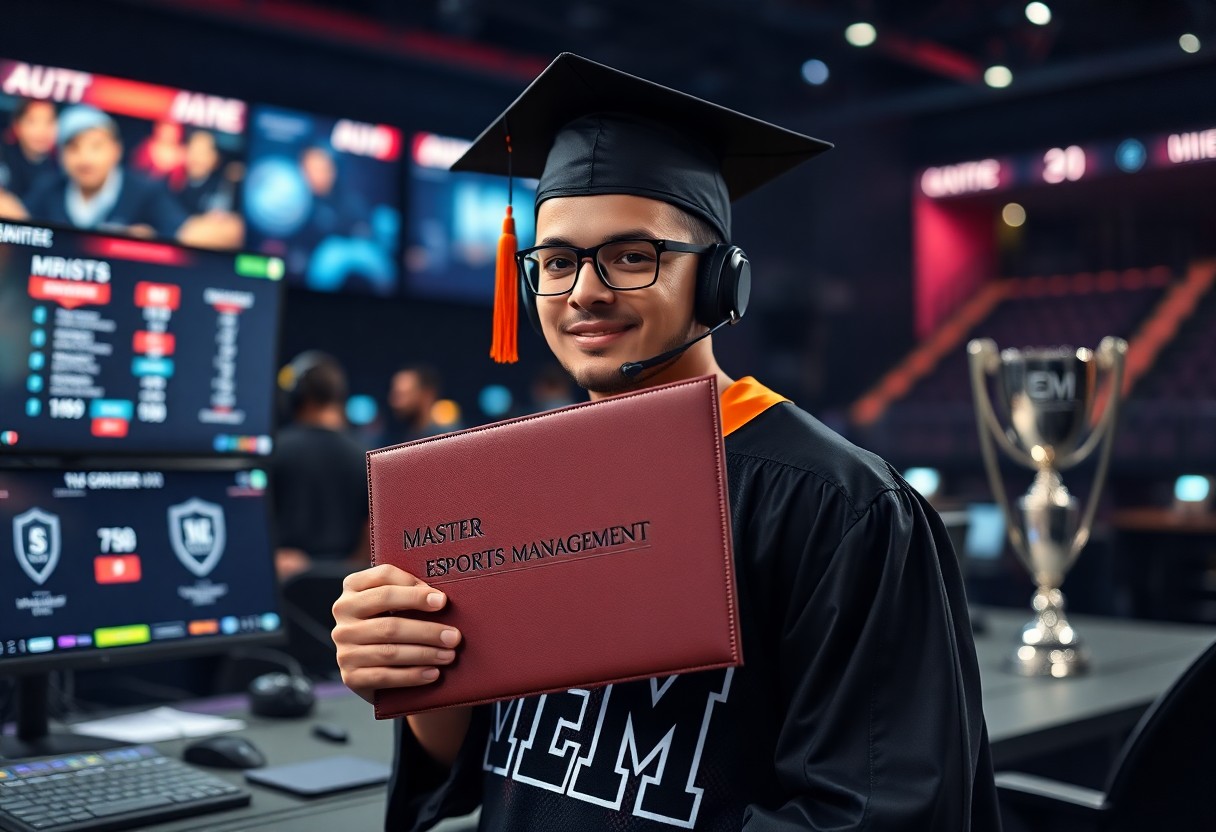
There’s a new arena where business strategy meets digital athleticism, and it’s redefining what it means to lead in entertainment. You’re no longer just managing teams or events-you’re shaping global franchises built on skill, spectacle, and streaming. The Master of Esports Management (MEM) equips you with the specialized framework to operate at the intersection of gaming, media, and commerce, where tournaments fill stadiums and sponsorships rival traditional sports.
Key Takeaways:
- A Master of Esports Management (MEM) equips professionals with specialized knowledge in event production, team operations, and digital marketing tailored to competitive gaming audiences.
- Programs often include partnerships with established esports organizations, such as collaborations with teams in the Overwatch League or regional LEC broadcasters, providing students with direct industry exposure.
- Curricula integrate traditional business disciplines-finance, leadership, and analytics-with niche subjects like in-game economy modeling and fan engagement strategies unique to digital platforms.
- Graduates have secured roles at companies like ESL Faceit Group and Riot Games, managing tournament logistics, sponsorship acquisition, and content distribution across streaming services.
- The degree addresses regulatory complexities, including player contract standards and cross-border broadcasting rights, preparing leaders to operate in a globally fragmented yet interconnected ecosystem.
The Digital Colosseum: Evolution of Competitive Gaming
Historical Foundations of Professional Play
You trace competitive gaming’s roots to early arcade tournaments in the 1980s, where titles like Space Invaders drew thousands of participants across North America. These events established the first formal structures for player ranking and prize distribution, laying groundwork for organized competition long before internet connectivity enabled global matchups.
Transition from Basements to Global Arenas
You recognize the shift from informal LAN parties to sold-out stadiums as a defining phase in esports history. Games like Counter-Strike and StarCraft cultivated dedicated followings in South Korea and Europe, where televised broadcasts and corporate sponsorships turned bedroom players into professional athletes with training schedules and team contracts.
South Korea’s 1999 launch of the Korea e-Sports Association (KeSPA) marked a turning point, institutionalizing player development and event production years ahead of Western markets. By the early 2010s, tournaments such as Major League Gaming’s events in the U.S. and ESL One in Germany filled convention centers, with live audiences exceeding 10,000 and prize pools growing through community-driven crowdfunding models.
The Cultural Tipping Point of Shared Digital Experience
You observe how streaming platforms like Twitch and YouTube Gaming transformed passive viewership into interactive spectatorship. Real-time chat, viewer donations, and emotes created a participatory culture where fans engage alongside players, turning major finals into communal events comparable to traditional sports playoffs or music festivals.
A single The International Dota 2 championship drew over one million concurrent viewers in 2013, a milestone that signaled mainstream cultural penetration. This collective engagement, amplified by social media and influencer participation, redefined what it means to be an audience member, merging fandom with digital identity and enabling global communities to form around shared gameplay narratives.
The Anatomy of an Esports Master’s Program
Core Curricula and Strategic Frameworks
Your coursework centers on organizational dynamics, revenue modeling, and competitive ecosystem analysis. You study sponsorship valuation, tournament logistics, and regulatory compliance, blending business theory with gaming industry specifics. Case studies from major leagues illustrate how strategic decisions shape long-term franchise viability.
Specialized Tracks in Media and Marketing
You focus on audience engagement, content distribution, and brand lifecycle management within digital platforms. Courses examine how streaming analytics, influencer partnerships, and community-driven campaigns amplify visibility. A mid-sized SaaS firm’s rebrand through Twitch integrations demonstrates real-world application.
Media and marketing tracks train you to identify emerging content trends before they peak. You analyze viewer retention patterns across platforms like YouTube Gaming and Kick, then develop monetization strategies using ad placements, virtual goods, and subscription tiers. Assignments include designing cross-platform campaigns that align with team identities and fan demographics.
Leadership in Non-Linear Systems
You learn to manage decentralized teams operating across time zones, platforms, and cultural contexts. Structures mimic actual esports organizations, where decision-making flows through agents, coaches, and content creators simultaneously. Adaptability replaces rigid hierarchy as the core leadership metric.
Non-linear leadership emphasizes responsiveness over control. You simulate crisis scenarios such as player controversies or platform outages, practicing rapid consensus-building among stakeholders. Training includes conflict resolution between talent agencies and league operators, where formal authority is limited but outcomes are high-stakes.
Economic Architecture of the Virtual Realm
Revenue Streams and Sponsorship Dynamics
You secure income through media rights, ticketed events, and branded content deals, with sponsors like automotive and tech firms aligning with high-engagement tournaments. Activation strategies now prioritize fan touchpoints across streaming platforms, where a mid-sized SaaS firm might gain visibility through in-game overlays during a regional finals broadcast.
Financial Sustainability in League Operations
You balance league budgets by standardizing team revenue shares and enforcing salary caps, mirroring models used by established circuits such as the Overwatch League’s early structure. Cost controls prevent overspending while ensuring competitive parity across franchises.
Operating a sustainable league demands transparent financial reporting and long-term partnership agreements. You implement centralized sponsorship pools so individual teams aren’t solely responsible for fundraising, reducing volatility. Franchise fees, collected upfront from team owners, provide initial operational liquidity while league-wide merchandising agreements generate recurring income streams tied to fan engagement metrics.
The Venture Capital Influence on Growth
You observe venture capital firms acquiring team stakes, drawn by scalable audience metrics and digital-first branding opportunities. A Silicon Valley fund might back an Apex Legends squad not for immediate returns but for strategic positioning within interactive entertainment’s expanding ecosystem.
Behind the scenes, venture investment reshapes organizational priorities, pushing teams to adopt data-driven performance analytics and expand into adjacent markets like content creation and talent management. You manage investor expectations by delivering quarterly growth metrics, user acquisition costs, and lifetime value projections, treating the esports team less as a sports entity and more as a tech-enabled media platform with global distribution potential.
Governance and the Rule of the Digital Law
Regulatory Challenges in Uncharted Jurisdictions
Operating across borders means confronting fragmented legal frameworks where esports often falls between traditional sports regulation and digital entertainment policy. A tournament hosted in Southeast Asia may involve players from Europe and prize pools funded through Middle Eastern sponsors, creating tax, labor, and compliance complications no single national law can resolve.
Ethical Management of Player Talent
Young competitors frequently sign contracts without legal counsel, exposing them to exploitative clauses around revenue sharing and image rights. You are responsible for ensuring transparency, fair compensation, and long-term career planning, especially when managing players under 18 who may lack financial literacy or agency.
Professional leagues have seen cases where organizations retain indefinite control over player identities and social media handles, effectively owning a core part of their personal brand. You must establish clear agreements that balance organizational investment with individual autonomy, modeling practices after athlete-centric frameworks seen in mature sports industries while adapting to digital ownership nuances.
Technological Integration and Future Infrastructure
As you advance in the Master of Science in Gaming and Esports Management, understanding the interplay between emerging technologies and infrastructure becomes central to shaping the next generation of competitive gaming experiences.
Impact of Low-Latency Connectivity and AI
Real-time decision-making in high-stakes tournaments depends on network speeds that minimize lag to imperceptible levels, allowing AI-driven analytics to process player behavior and audience engagement with precision previously unattainable in live digital environments.
Designing the Stadiums of Tomorrow
Physical venues are evolving into hybrid spaces where digital overlays and live观众 interaction merge, creating immersive environments that transcend traditional boundaries of spectatorship.
Augmented reality displays now guide attendees through event spaces, while dynamic seating configurations adapt to different formats, from solo showdowns to massive team-based finals, ensuring each event delivers a tailored experience shaped by data collected from past attendance patterns and viewer preferences.
Career Trajectories for the Modern Executive
Roles Beyond the Keyboard
Your expertise extends far beyond gameplay, positioning you for leadership in operations, marketing, and talent management within professional teams and gaming organizations.
Networking within the Global Ecosystem
Connections made during your program open doors to collaborations across regions, linking you with tournament organizers, sponsors, and media platforms active in major esports markets.
Building relationships at industry summits and through university-affiliated events introduces you to decision-makers at companies like ESL and Riot Games, where partnerships often form the foundation of executive opportunities. A mid-sized SaaS firm supporting team analytics recently hired a graduate to bridge technical capabilities with league requirements, illustrating how access translates into placement.

To wrap up
You are positioned at the intersection of sports, technology, and global entertainment with the Master of Esports Management (MEM). This degree equips you with specialized frameworks used by leading organizations to scale tournaments, manage player contracts, and monetize digital audiences. A graduate from a recognized MEM program might find themselves overseeing operations for a major league organizer or shaping policy within an international gaming federation. The program’s structure reflects real-world demands, blending business acumen with sector-specific knowledge, preparing you to lead in a field where traditional management models no longer apply.