
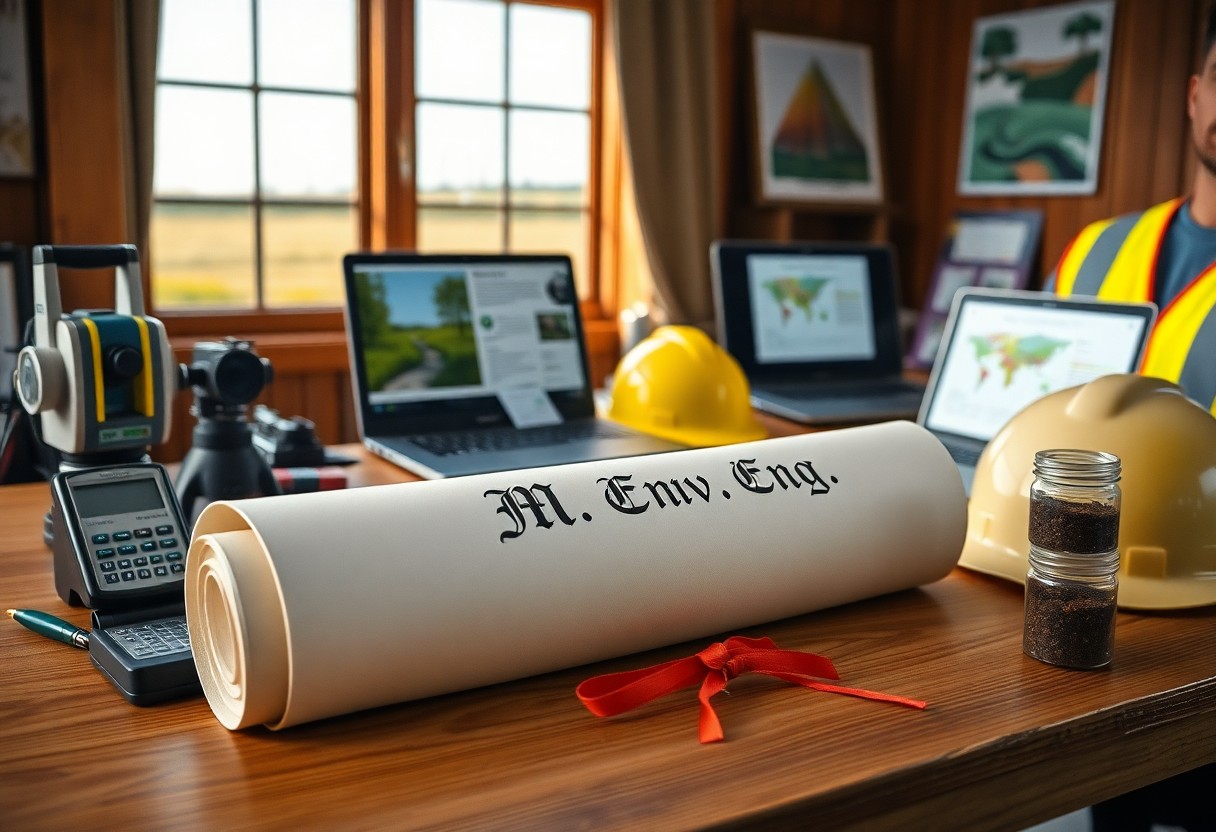
Engineering your role in solving pressing environmental challenges begins with the Master of Environmental Engineering (M.Env.Eng.). You gain advanced skills in pollution control, sustainable design, and environmental systems. This degree prepares you to lead in public agencies, consulting firms, or research with real-world impact.
Key Takeaways:
- The Master of Environmental Engineering (M.Env.Eng.) is a graduate-level program focused on solving environmental challenges through engineering solutions, such as water treatment, air quality control, and waste management.
- Students gain technical expertise in areas like environmental chemistry, fluid dynamics, and sustainable design, preparing them for roles in industry, government, or consulting.
- Many programs offer a mix of coursework and applied projects, allowing students to address real-world problems like pollution reduction and climate resilience.
- Admission typically requires a bachelor’s degree in engineering or a related science, with some programs preferring applicants who have professional experience.
- Graduates often pursue careers in environmental consulting, regulatory agencies, or research, with opportunities to contribute to cleaner, safer, and more sustainable communities.
The Call of the Wild and the Machine
You stand where engineered systems meet natural forces, where water treatment plants mirror wetlands and green infrastructure breathes life into concrete cities. Your training turns this intersection into a laboratory, not a battleground. Nature doesn’t resist technology here-it guides it. You learn to listen, then build.
The Discipline of the Scholar
Your success in the Master of Environmental Engineering program hinges on consistent effort and intellectual rigor. Daily engagement with complex systems, from water treatment models to air quality simulations, demands focus and precision. You are expected to uphold high academic standards while advancing practical solutions to real-world environmental challenges. This discipline shapes not only your expertise but also your responsibility as a future leader in the field.
The Restoration of Natural Balance
You play a direct role in reversing environmental degradation by restoring ecosystems to their natural state. Through targeted interventions like wetland rehabilitation and soil remediation, you help reestablish the delicate equilibrium disrupted by human activity. The Environmental Engineering, M.S. – NYU Tandon program equips you with the technical depth to design solutions that align with ecological rhythms and long-term sustainability.
The Economics of the Living World
You assess how natural systems contribute to economic stability, measuring ecosystem services like clean water, pollination, and carbon sequestration in tangible terms. Every decision in environmental engineering carries financial implications, and understanding cost-benefit dynamics ensures sustainable outcomes. Your analysis bridges ecology and economics, revealing how protecting nature often yields long-term savings and resilience.
The Duty of the Engineer
You uphold public safety, health, and environmental integrity in every design and decision. Your calculations do more than solve technical problems-they protect communities and ecosystems. Ethical responsibility guides your work, demanding honesty, accountability, and long-term thinking. You answer not only to clients or employers but to society and the planet. Engineering is a service, and your duty is to serve with precision and care.
Conclusion
Considering all points, the Master of Environmental Engineering (M.Env.Eng.) equips you with advanced technical and analytical skills to address complex environmental challenges. You gain expertise in sustainable design, pollution control, and regulatory frameworks, positioning you to lead impactful projects in public and private sectors. This degree strengthens your ability to develop effective, science-based solutions for real-world environmental issues.