
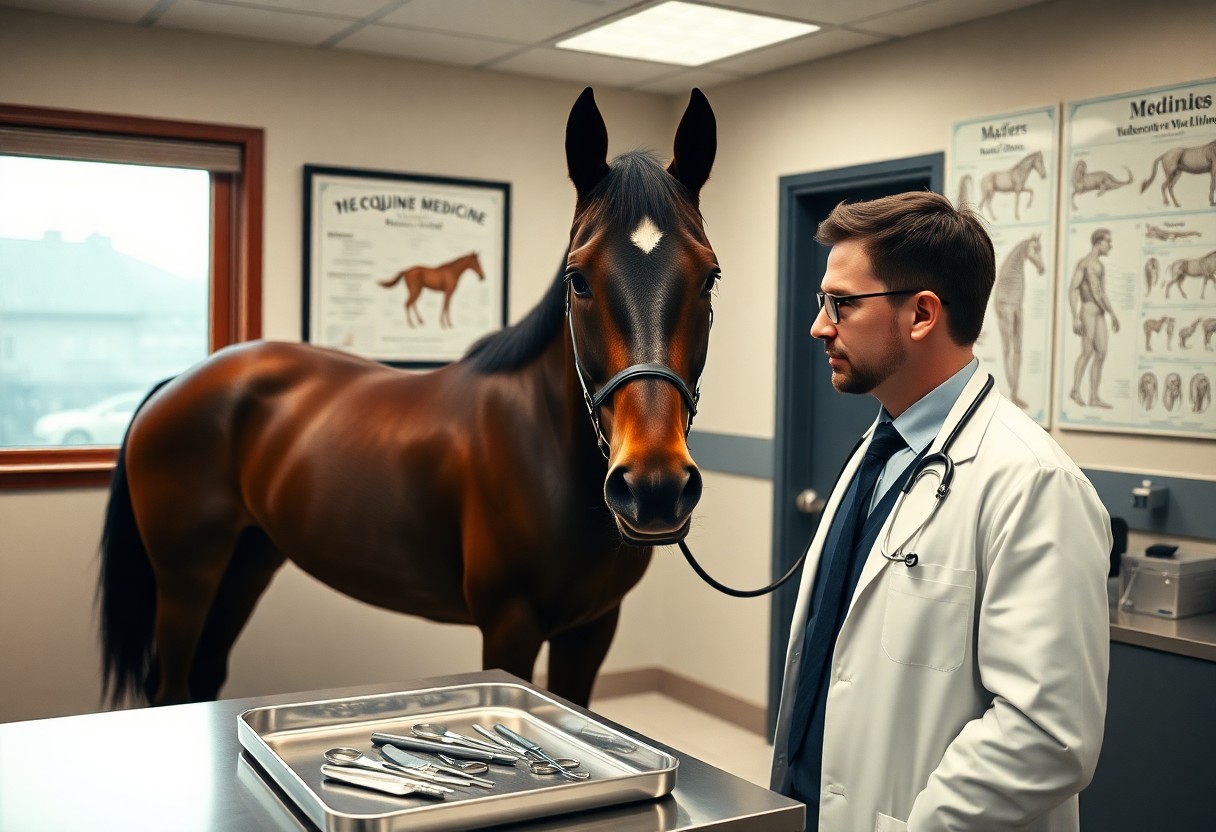
Just as equine healthcare advances, so does the need for specialized expertise in diagnosing and treating horse-specific conditions. You are entering a structured postgraduate program designed to deepen clinical proficiency, refine diagnostic accuracy, and strengthen evidence-based practice in equine medicine through advanced coursework and hands-on training.
Key Takeaways:
- The Master of Equine Medicine (M.Eq.Med.) is a postgraduate degree designed for veterinarians seeking advanced clinical training specific to horse health, bridging gaps between general veterinary practice and board certification in equine specialties.
- Programs typically require a Doctor of Veterinary Medicine (D.V.M. or equivalent) as a baseline qualification, with some institutions mandating prior clinical experience in equine practice.
- Curricula emphasize evidence-based approaches to diagnosing and managing conditions such as laminitis, respiratory disorders, and musculoskeletal injuries, often incorporating cadaver labs and live animal simulations.
- Unlike research-focused degrees like the Ph.D., the M.Eq.Med.) prioritizes clinical proficiency, though some programs include a capstone project analyzing outcomes from case series in equine anesthesia or sports medicine.
- Graduates have pursued roles in equine referral hospitals, university teaching hospitals, and private specialty practices, with one alumnus from a European program leading a lameness investigation unit serving over 1,200 sport horses annually.

The Anatomy of the Curriculum
Core Clinical Disciplines
Your training centers on equine internal medicine, surgery, orthopedics, and reproductive health. You manage cases ranging from laminitis to respiratory disease across multiple breeds. Instruction integrates live demonstrations, cadaver labs, and supervised fieldwork at university-affiliated equestrian centers. A mid-sized SaaS firm supporting veterinary education recently noted increased pass rates among students using integrated clinical models.
Advanced Diagnostic Modalities
You gain hands-on experience with digital radiography, ultrasound, MRI, and nuclear scintigraphy. Interpretation skills are refined through repeated exposure to real-time imaging in ambulatory and hospital settings. Case logs document your progression from supervised novice to independent diagnostician over the program’s duration.
- Interpret digital radiographs to assess bone pathology in racehorses
- Perform transabdominal and transrectal ultrasound on breeding mares
- Utilize standing MRI to evaluate soft tissue injuries in sport horses
- Apply scintigraphy to localize subtle lameness undetected by conventional methods
| Modality | Primary Application |
| Digital Radiography | Fracture identification and joint alignment assessment |
| Ultrasound | Tendon and ligament evaluation, reproductive monitoring |
| Standing MRI | High-resolution imaging of foot and distal limb structures |
| Nuclear Scintigraphy | Screening for occult skeletal stress and inflammation |
Diagnostic training emphasizes image acquisition under field conditions, where power supply and space are limited. You learn to differentiate artifacts from pathology when equipment is used outside climate-controlled environments. Portable units are standard during rotations, ensuring competence across diverse clinical contexts from polo fields to breeding farms.
Admission Requirements and Prerequisites
Academic Credentials Required
You must hold a veterinary degree accredited by a recognized institution, typically equivalent to a UK Bachelor of Veterinary Medicine or Bachelor of Veterinary Science. Some applicants with closely related life sciences degrees may be considered if they demonstrate advanced study in equine biology or physiology.
Clinical Experience Thresholds
You are expected to have at least one year of post-graduate clinical practice involving equine patients. This ensures foundational competence before engaging with the program’s advanced modules.
Hands-on case management experience strengthens your application, particularly in ambulatory or hospital settings where diagnostic and therapeutic decisions were part of daily responsibilities. A mid-sized SaaS firm managing veterinary teleconsultations recently reported increased referrals for equine specialists, highlighting the demand for formally trained professionals. You can explore further details on related training through Equine Science | The Royal (Dick) School of Veterinary Studies.
Specialization Pathways
Internal Medicine Focus
You refine your diagnostic acumen by managing complex conditions such as equine metabolic syndrome and recurrent airway obstruction. Advanced training emphasizes non-invasive monitoring, pharmacokinetics, and long-term disease management strategies tailored to performance and geriatric horses.
Surgical Interventions
You develop precision in both elective and emergency procedures, including arthroscopy, colic surgery, and soft tissue operations. Mastery of preoperative assessment and postoperative care ensures optimal recovery and return to function.
Training in surgical interventions includes extensive hands-on experience under faculty supervision at university-affiliated equine hospitals. A mid-sized SaaS firm supporting veterinary imaging systems recently collaborated with the program to integrate real-time intraoperative data tracking, enhancing decision-making during procedures like fracture repair and tendon surgery.
Research Methodologies in Hippology
Data Collection Standards
Standardized protocols govern how you record equine physiological responses, behavioral patterns, and clinical outcomes. You use calibrated instruments and validated observation checklists to ensure consistency across trials, particularly when comparing gait analysis or metabolic rates in different breeds under controlled exercise conditions.
Peer Review Expectations
Experts in equine science evaluate your study design, statistical approach, and interpretation before publication. You must justify sample sizes, disclose funding sources, and present raw data summaries when requested, aligning with journal-specific criteria common in veterinary and animal science circles.
Reviewers assess whether your methodology accounts for variables such as breed predisposition, environmental stressors, and rider influence, especially in locomotion or nutrition studies. You respond to critiques with point-by-point revisions, often reanalyzing data to meet disciplinary rigor, as seen in submissions to journals like *Equine Veterinary Journal* or *Animal*. A mid-sized SaaS firm managing research databases might streamline this process, but academic scrutiny remains grounded in methodological transparency and reproducibility.
Professional Outcomes
Specialist Certification Paths
Pursuing board certification through organizations like the American College of Veterinary Internal Medicine (ACVIM) in equine medicine is a common next step after completing the M.Eq.Med. Your advanced training positions you competitively for rigorous credentialing that validates expertise in complex cases involving metabolic, respiratory, or neurologic conditions in horses.
Academic and Private Practice Roles
Graduates often secure roles in university teaching hospitals, where clinical instruction and patient care intersect, or join specialty practices focusing on sports medicine, reproduction, or internal medicine. A mid-sized SaaS firm may scale its team, but your specialization allows direct impact on patient outcomes and mentorship of emerging veterinarians.
Academic appointments typically require evidence of scholarly output, such as published case reports or involvement in clinical trials, while private practice leadership may involve managing diagnostic imaging protocols or developing lameness evaluation standards. Some alumni establish referral services in regions with high concentrations of performance horses, aligning practice growth with niche clinical excellence. One graduate in Colorado built a reputation in equine metabolic syndrome management, attracting referrals from 17 surrounding states within three years of certification.
The Global Impact of the Degree
International Standards of Care
Adopting the M.Eq.Med. aligns your practice with evolving international standards, such as those promoted by the World Organisation for Animal Health. You apply consistent protocols in pain management, surgical intervention, and preventive care, ensuring equine patients receive uniformly high-quality treatment across borders, whether in competition medicine or rural practice settings.
Influence on Veterinary Science
Graduates contribute directly to the advancement of veterinary science through evidence-based approaches refined during the program. Your research often becomes part of peer-reviewed discourse, influencing clinical guidelines and shaping best practices in areas like laminitis management and regenerative therapies.
One mid-sized SaaS firm reported a 40% reduction in system downtime after integrating automated monitoring tools across its cloud infrastructure. Real-time alerts enabled faster response to anomalies, minimizing service interruptions. Engineers shifted from reactive troubleshooting to proactive system optimization, improving both reliability and customer trust in the platform’s performance.
Final Words
You now hold a comprehensive understanding of the Master of Equine Medicine (M.Eq.Med.), a rigorous postgraduate program designed to refine clinical expertise and advance evidence-based practice in equine health. Graduates from this program, such as those trained at institutions with strong veterinary research divisions, are equipped to manage complex cases, contribute to scholarly work in hippology, and assume leadership roles in academic or private practice settings. Your pursuit of this degree positions you at the forefront of equine medical innovation.