
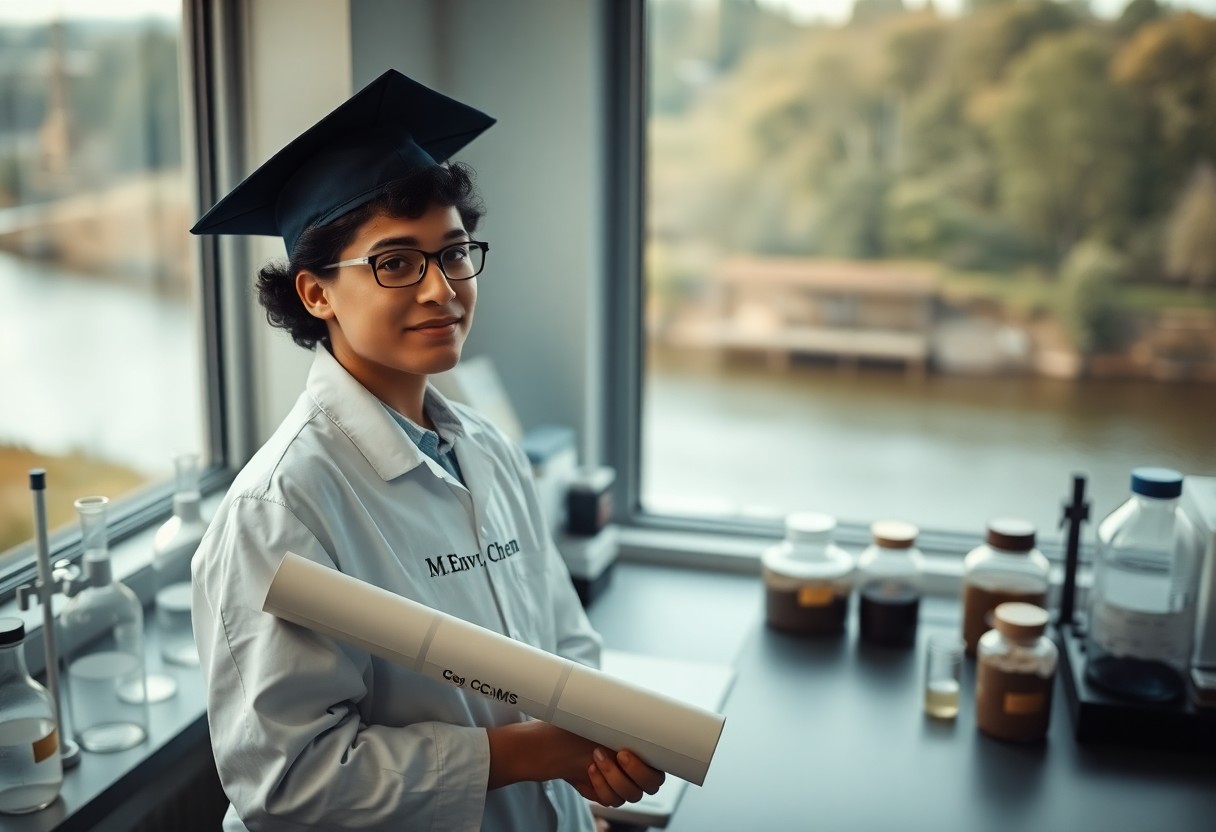
There’s a growing demand for experts who understand the chemical processes shaping our natural world. You’re pursuing the Master of Environmental Chemistry (M.Env.Chem.) to gain advanced knowledge in pollution analysis, remediation strategies, and environmental monitoring. This program equips you with the scientific rigor needed to address real-world environmental challenges.
Key Takeaways:
- The Master of Environmental Chemistry (M.Env.Chem.) is a specialized graduate program focused on understanding chemical processes in natural and polluted environments, including air, water, and soil systems.
- Students gain hands-on experience analyzing contaminants, studying pollutant behavior, and evaluating remediation strategies through laboratory work and field studies.
- The curriculum integrates core chemistry principles with environmental science, covering topics like toxicology, environmental monitoring, and analytical methods.
- Graduates are prepared for careers in environmental consulting, regulatory agencies, research institutions, or further academic study in environmental sciences.
- Programs often require a thesis or capstone project, allowing students to investigate real-world environmental issues such as heavy metal pollution or emerging contaminants like microplastics.
The Alchemy of the Elements
You stand where chemistry meets Earth’s living systems, tracing how elements transform across air, water, and soil. This is environmental chemistry-not just reactions in a flask, but dynamic exchanges shaping life and climate. You learn to read the signatures of change, from molecular shifts to global cycles.
Atmosphere and Breath
Every breath you take pulls reactive compounds into your body, linking personal health to atmospheric chemistry. You analyze trace gases, aerosols, and pollutants that alter climate and air quality. Your measurements reveal how human activity reshapes the sky’s delicate balance.
The Deep Waters
Ocean depths hold ancient water masses, slowly circulating and storing carbon for centuries. You probe their chemistry to understand how dissolved oxygen, nutrients, and pollutants move through marine systems. These hidden flows shape global biogeochemical cycles in ways surface waters cannot.
Deep ocean currents act as Earth’s chemical circulatory system, transporting dissolved inorganic carbon, trace metals, and isotopic signatures across basins. You examine how hydrothermal vents release minerals that fuel microbial life, while sinking organic particles sequester carbon. These processes regulate long-term climate patterns and reveal how perturbations at the surface echo in the abyss.
The Scholar’s Path
You follow a trail shaped by inquiry, where every course builds your understanding of Earth’s chemical rhythms. This degree sharpens your ability to interpret environmental change through precise analytical methods and scientific reasoning, preparing you to contribute meaningfully to ecological stewardship and research.
Curricula of the Wild
Fieldwork defines this component, taking you beyond classrooms into forests, wetlands, and urban ecosystems. You analyze real-world samples, track pollutant dispersion, and assess environmental health, grounding theoretical knowledge in direct observation and hands-on data collection.
Laboratory Rites
Each experiment refines your precision, from calibrating instruments to detecting trace contaminants in water or soil. You master protocols that ensure accuracy, learning to trust data shaped by discipline, repetition, and meticulous attention to chemical behavior under controlled conditions.
Within Laboratory Rites, you engage in advanced analytical techniques such as gas chromatography-mass spectrometry and atomic absorption spectroscopy. These tools allow you to quantify pollutants at parts-per-billion levels, interpret complex datasets, and validate findings through peer-reviewed methodologies. Lab work becomes a disciplined practice, where consistency and technical rigor form the foundation of credible environmental science.
Tools of Observation
Mastering environmental chemistry requires more than theory-it demands precise tools to detect invisible changes. You’ll use advanced instrumentation to measure pollutants, track chemical transformations, and validate sustainability claims. Explore Graduate Programs in Green and Sustainable Chemistry to deepen your expertise in real-world applications.
Analytical Precision
Accuracy defines your success in identifying trace contaminants. You operate high-resolution mass spectrometers and chromatography systems to quantify substances at parts-per-billion levels. Every reading informs environmental risk assessments and shapes remediation strategies with scientific integrity.
Field Inquiries
Real-world data begins where the lab ends. You collect water, soil, and air samples from diverse ecosystems, ensuring protocols preserve sample integrity. These field efforts ground your analysis in environmental reality.
Field inquiries teach you to adapt methods to dynamic conditions-rainfall, temperature shifts, or remote access challenges. You log geographic coordinates, environmental variables, and contextual notes that transform raw samples into meaningful datasets. This hands-on experience sharpens your ability to link laboratory findings with ecosystem health.
The Burden of Industry
Industrial activity leaves invisible marks that persist long after factories fall silent. You inhale the residue of progress in urban air, drink its runoff from rivers, and walk on soil laced with decades of chemical trade-offs. This legacy shapes environmental chemistry’s urgent mission.
Pollutants and Residue
Heavy metals, persistent organic compounds, and synthetic byproducts accumulate in ecosystems you depend on. These residues resist natural breakdown, entering food chains and altering biological functions. Your exposure begins at microscopic levels, often undetected until damage surfaces.
Remediation of the Soil
Contaminated ground doesn’t heal on its own. You must intervene with precision, using chemical stabilization, phytoremediation, or microbial digestion to restore balance. Each method targets specific toxins, demanding deep understanding of soil composition and pollutant behavior.
Soil remediation requires more than surface treatment. You analyze subsurface chemistry to determine whether contaminants are bound, mobile, or degrading. Techniques like electrokinetic extraction or in-situ oxidation alter pollutant states directly in the ground, minimizing disruption while maximizing recovery. Your choices shape long-term land usability and ecological recovery.
The Professional Calling
You step into a role where science meets responsibility. Every analysis, every field sample, every report contributes to a clearer picture of environmental health. This is not just a career-it’s a commitment to understanding how chemicals move through air, water, and soil, and how they affect life at every level.
Guardians of the Earth
You stand on the front lines of environmental protection. Your expertise detects pollutants before they spread, identifies contamination sources, and helps restore damaged ecosystems. This role demands precision, ethics, and a deep sense of duty to safeguard natural systems for future generations.
Policy and Principle
You shape regulations grounded in scientific truth. Your assessments inform air quality standards, water safety limits, and chemical use policies. When data drives decisions, communities gain protection that is both fair and effective, balancing public health with environmental integrity.
Policy without accurate chemistry is guesswork. You provide the measurable, repeatable evidence that turns intention into action. Whether testifying before regulatory bodies or designing monitoring protocols, your work ensures that laws reflect real-world conditions. Science becomes a tool for justice, and you are the one calibrating it with care and consistency.
Final Words
Summing up, you gain advanced expertise in chemical processes affecting the environment through the Master of Environmental Chemistry (M.Env.Chem.). You develop the analytical skills to assess pollutants, interpret environmental data, and contribute to solutions for pressing ecological challenges. This degree positions you to lead in research, industry, or policy with scientific rigor and clarity.