

Just enroll to gain practical skills in digital business strategy and startup management; you will master market analysis, product development, funding strategies, and digital marketing to launch and scale ventures successfully.
Key Takeaways:
- MEBD combines entrepreneurship training with digital business skills, covering startup methodology, digital strategy, product management, data analytics, e-commerce, and fundraising.
- Programme emphasizes hands-on learning through real-world projects, a capstone venture, mentorship, and industry internships that build investor-ready business plans and pitch experience.
- Graduates qualify for roles as startup founders, product managers, digital strategists, innovation managers, or consultants, with practical skills to launch and scale digital ventures.
Core Foundations of Digital Entrepreneurship
You should master customer discovery, digital business models, scalable technology stacks, analytics, and agile operations to create sustainable ventures and measurable growth.
Evolution of the Digital Economy
Markets have shifted from physical-first commerce to platform-centric, data-driven ecosystems where you must adapt business models, monetization, and customer experience rapidly.
Strategic Innovation and Disruptive Models
Design thinking and experimentation guide how you test new value propositions, iterate quickly, and challenge incumbents with lower-cost or higher-value alternatives.
Experimentation lets you validate business-model shifts, exploit platform strategies, harness network effects, and use MVP-driven metrics to scale or pivot before incumbents react.
Curriculum Architecture and Specialized Tracks
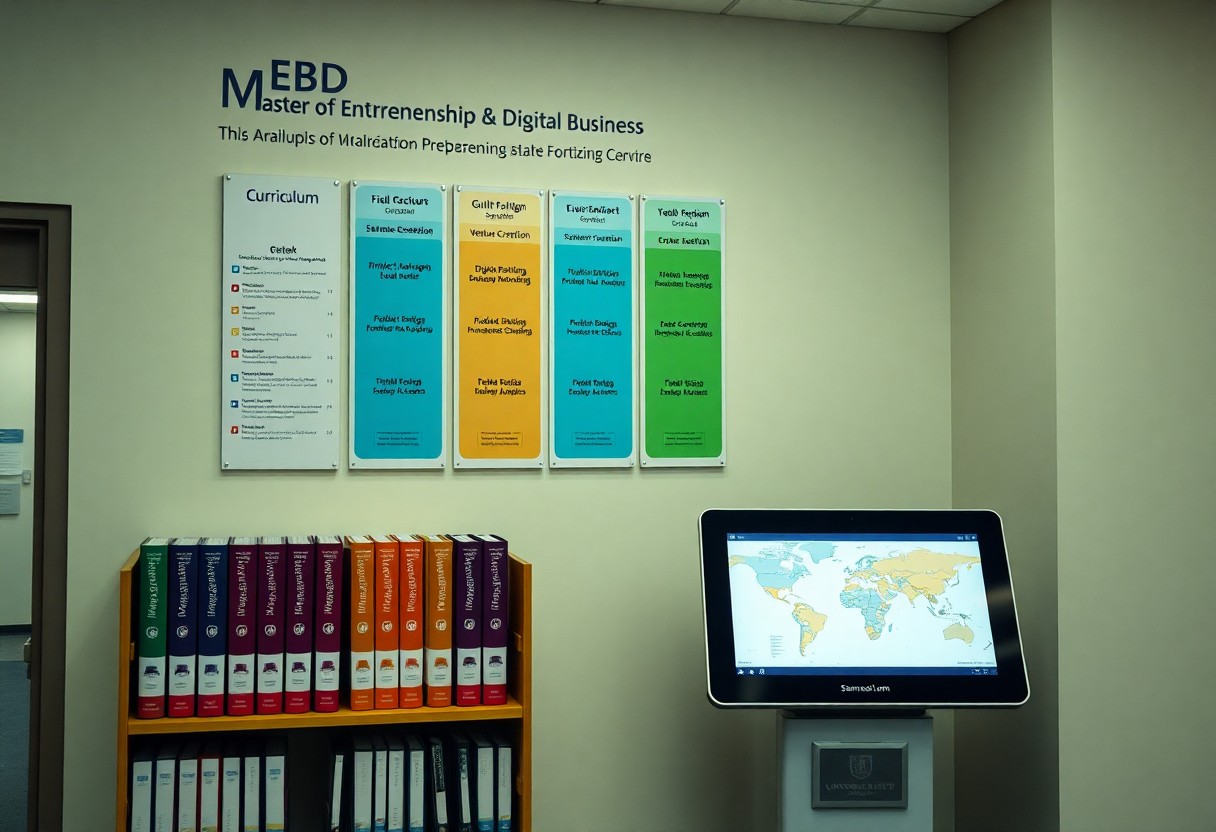
Curriculum maps core competencies to flexible electives so you build business fundamentals, digital capabilities, and venture skills through targeted tracks, labs, and a practical capstone that simulates real startup challenges.
Data Science and Predictive Analytics
Data Science track trains you in statistical modeling, machine learning, and forecasting so you convert customer and operational data into predictive insights that guide product, marketing, and investment choices.
E-commerce Systems and Platform Management
E-commerce track teaches you platform architecture, payment integration, order workflows, and operations to run scalable online businesses while improving conversion and lifetime value.
You learn to choose between headless and monolithic platforms, design API-driven integrations for payments, inventory, and CRM, and set up order management and fulfillment flows that scale. You implement analytics, A/B testing, internationalization, and compliance measures while managing vendors, SLAs, and uptime to protect conversion and customer trust.

Financial Engineering for Tech Ventures
You optimize capital structure through convertible instruments and dynamic cash-flow models, aligning funding with product milestones and exit pathways.
Venture Capital and Private Equity Landscapes
Assessing how VCs and PE firms evaluate scalability, you learn term-sheet mechanics, dilution dynamics, and staged financing approaches that match technological risk with growth runway.
Sustainable Scaling and Monetization Strategies
Designing repeatable revenue models teaches you pricing experiments, unit-economics discipline, and channel optimization to extend margins while preserving product-market fit.
Consider testing tiered pricing, freemium conversions, usage-based billing, and long-term contracts; you model churn, CAC payback, and contribution margins to forecast runway and prioritize investments that sustain growth.
Digital Marketing and Growth Hacking
Digital strategies teach you to test, scale, and optimize channels quickly, turning small experiments into measurable growth while prioritizing conversion metrics and retention.
Performance-Based Customer Acquisition
Performance-driven campaigns let you pay for outcomes, focusing budget on channels that deliver cost-per-acquisition targets and predictable ROI through rigorous tracking and split testing.
Brand Positioning in a Hyper-Connected Market
Positioning clarifies how you stand out across platforms, shaping consistent messaging, customer perception, and social proof to attract attention and build trust.
You should audit every touchpoint, align tone and visuals to target segments, monitor sentiment metrics, and iterate messaging based on engagement data; consistent story and community interactions make your brand memorable across noisy channels.
Leadership and Human Capital Management
Leadership in human capital directs hiring, development and retention so you shape strategy, set incentives, and measure performance to scale teams toward business goals.
Cultivating an Agile Corporate Culture
Culture that values rapid learning helps you adapt processes, reward informed risk-taking, and shorten decision cycles to keep products and teams responsive.
Managing Remote and Distributed Teams
Managing remote teams requires clear goals, synchronous and asynchronous communication protocols, and regular check-ins so you maintain cohesion and performance across locations.
You should standardize onboarding, define measurable outcomes, schedule overlap windows for collaboration, and equip managers with coaching skills for asynchronous feedback; use visibility dashboards, documented workflows, and deliberate social rituals to reduce isolation and improve retention across time zones.
Legal Frameworks and Ethical Governance
You align company policies with statutes and ethical standards, using sources such as MS in Entrepreneurship & Management | NYU SPS to refine governance and risk controls.
Intellectual Property and Digital Rights
Protect your innovations by registering trademarks, patents, and copyrights while drafting clear licensing and terms of use for digital assets.
Data Privacy and Regulatory Compliance
Comply with applicable privacy laws, implement consent mechanisms, and maintain audit trails so your business withstands scrutiny and reduces exposure.
When you map data flows and classify sensitive datasets, tailor retention schedules, encryption requirements, and role-based access to meet regional laws; document processing activities, appoint a privacy lead as required, and run periodic audits to demonstrate compliance and speed breach response.
Summing up
You will gain practical skills in entrepreneurship, digital strategy, and product development through the MEBD, enabling you to launch ventures, manage digital transformation, and make data-driven decisions that advance your business goals.
FAQ
Q: What does the Master of Entrepreneurship and Digital Business (MEBD) program cover and how is it structured?
A: The MEBD program combines core business disciplines with applied digital skills to prepare students for founding or scaling ventures and leading digital transformation. Core modules often include business model design, startup finance and fundraising, digital marketing and growth, product management, data analytics for decision-making, user experience and design thinking, and legal issues for startups including intellectual property and contracts. Program formats typically feature project-based learning, a capstone venture or incubator placement, and industry-focused internships or consultancy projects. Program length varies by provider; common formats are 12-24 months full-time or 24-36 months part-time, with credit requirements ranging from 60 to 120 ECTS or equivalent. Assessment methods usually combine group projects, pitch presentations, written assignments, and live client work rather than only exams.
Q: Who is the MEBD aimed at and what career outcomes can graduates expect?
A: The MEBD targets aspiring founders, early-stage startup team members, intrapreneurs within established firms, product managers, growth marketers, and consultants working on digital transformation. Students with technical, design, or business undergraduate backgrounds can succeed if they bring a willingness to build and test business ideas. Graduates commonly move into roles such as startup CEO/co-founder, product manager, growth lead, innovation manager, digital strategy consultant, or venture analyst at VCs and accelerators. Skill outcomes include business model validation, fundraising and investor pitching, customer acquisition through digital channels, product roadmapping and MVP development, basic data analysis for growth, and practical experience running or advising small ventures.
Q: What are typical admission requirements, costs, and funding options for MEBD programs?
A: Admissions usually require a bachelor’s degree or equivalent, a CV, a statement of purpose outlining entrepreneurial or digital interests, and one or two references. Programs may ask for evidence of prior work or startup experience, a portfolio for candidates from design or tech backgrounds, and English proficiency test scores for international applicants. Standard application steps include an online form, transcript submission, and an interview. Tuition fees vary widely by country and institution; public universities often charge lower rates while private schools can be substantially higher, with a common range from about USD 10,000 to USD 40,000 per year. Scholarships, merit-based grants, research or teaching assistantships, deferred tuition schemes, and partnerships with incubators or regional development funds can reduce net cost. Many programs also support entrepreneurship through seed funding, pitch competitions, and access to mentor networks and investors.